Please Remain Seated: A Reverse-Engineering Case Study on Over-The-Shoulders-Restraints
- henryolson34
- Jun 11
- 4 min read
If you’ve ridden an inverting coaster, you’ve most likely felt the pressure of a restraint lowering overhead. This article aims to explain where these safety devices originated from, what their purpose is + how it’s evolved, and how operators ensure this system's efficiency.
While roller coasters utilize countless systems and hidden technologies to optimize guest safety, some of the most eye-catching and widely recognized examples are OTSRs (also known as Over-The-Shoulders-Restraints). My name is Henry Olson, and if you’re ready to learn more about this complex system, please remain seated and do not pull down on the safety bar; an attendant will be lowering it for you shortly.
The History of Over The Shoulder Restraints
Roller coasters, or at least prior iterations of them, have been around for over 150 years; the first adaptation even dates back to around 1850.
All things considered though, it didn’t have nearly the same amount of precautionary measures that modern coasters include.
With any new type of technology, adaptations and changes are bound to occur. For coasters, OTSRs have been some of the most impactful. Prior to the first OTSR iteration, inverting on a track-based ride was deemed too forceful. This soon changed, as engineers pitched a solution: adding pull down safety bars to the Corkscrew coaster at Knott’s Berry Farm.
Ride designers grappled with this question: how can you turn riders upside down without them falling out? Karl Bacon and Ron Toomer developed a U-shaped solution to this problem.
While working in a development team at Arrow Dynamics, Bacon & Toomer proposed that a lowering restraint located behind the rider’s head could secure the rider’s torsos in place; and by using lock features, ops could maintain control over the system at all points during the ride.
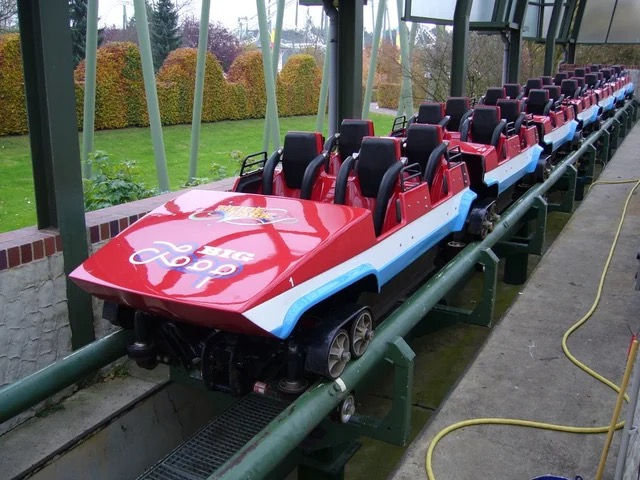
Following this innovative proposal, other theme parks around the world began adopting safety bars as a standard protocol for user safety. The second ride to open with OTSRs was the Great American Revolution at Six Flags Magic Mountain, proudly showcasing a modernized vertical loop. Thanks to Bacon and Toomer, ride engineers across the globe could assure that riders remained seated during intense loops and inversions.

Especially since the 2000s, it’s rare to see an inverting coaster that doesn’t use some version of an OTSR. With this being said, if you’ve visited newer theme parks, such as Epic Universe in Orlando, you’ve probably noticed a shift away from overhead restrictions to something more freeing. Lap bars specifically have gained prevalence as a less restrictive alternative to OTSRs.
Even though alternatives have been popularized, OTSRs still show up on new and innovative coasters such as Siren’s Curse at Cedar Point.
How they work
Not all coasters or amusement rides use OTSRs, but all of them operate with safety-based features. For smaller kiddie coasters, this could be a seatbelt or lap bar. But for more thrilling attractions with more force, OTSRs can be some of the most effective solutions to rider safety.
The two most common kinds of OTSRs are either automatically or manually lowered. Hearing the words “Please raise your hands in the air, as the over the shoulder restraints will now be lowering”, or “Please pull down on the overhead restraints” is a common occurrence on inverting coasters.
Although these signal phrases might not create a huge difference in rider minds, they signal two very different types of OTSRs, each with their own functions and locking technology.
First, one of the most common versions of the OTSR is secured using hydraulics alongside an attachment seatbelt located at the crotch area of the seat. Conversely, restraints can also be held in place using two independent locking pins behind the rider’s head.

On the most extreme rides, a magnetic sensor can also be found behind rider heads in order to ensure that the restraint remains at an optimal position during the ride’s duration. This way, if anything were to malfunction during the ride’s duration, the operator would be notified through a centralized computer system.
Keeping Accessibility in mind: How Pull-Down Restraints have been designed keep all guests at the forefront
Several design iterations have been introduced to make sure guests of all kinds can ride thrilling attractions. For example, a student-led group project at the Rochester Institute of Technology was aimed at designing a more conventional passenger restraint system for roller coasters.
Led by Mike Troise, an engineering group of theme park enthusiasts created a vest system that incorporated several locking systems on the back to ensure the ridability for people with disabilities, but also to allow for more free movement of limbs while on extreme force rides.

By transforming the traditional “bulky” style of restraint into harness-style vests and highly specialized/adjustable supports, the theme park world is working to ensure more fans can ride their favorite attractions while feeling safer and more seen.
The Future Of Safety: How Pull Down Restraints Can Evolve
With roller coasters and theme parks gathering millions of visitors each year, it’s important to shift the conversation to representation within ride design. With countless disabled and physically unique visitors each year, how can coasters evolve to expand participation?
Well, solutions like the one Troise designed are shifting attention in the right direction. Adding more cushioning and flexibility to restraints can ultimately expand the number of people who can ride coasters in the future.
Although there remains a delicate balance between firm support and adjustability, pushing the boundaries to experiment and test new solutions is what will eventually allow more guests to enjoy the thrills of amazing attractions.
References
https://www.timetoast.com/timelines/roller-coasters-over-the-years#:~:text=Jan%201%2C%201953%2C%20The%20world%27s%20first%20major%20roller%20coaster%20was%20made.%20Jan%201%2C%201959%2C%20The%20world%27s%20first%20tubular%20steel%20tracked%20roller%20coaster.%20Jan%201%2C%201981%2C%20The%20first%20suspended%20roller%20coaster%20was%20built.

Comments